Showing posts with label others. Show all posts

Saturday, 31 August 2013

0 SOME USEFUL WEBSITE FOR ENGINEERING STUDENTS..!!

Engineering is not science. Engineers generally don't "do" science. Science is about discovering the natural. Engineering is creating the artificial. Well when we come across a term engineer we think a lots about of it. We think engineer can do this . engineer can do that but only an engineer knows what he can do and how. So today this post of mine is to help the engineers. I am going to provide a list of some websites to help engineer to understand their topics and problems. I hope you will like this collection. So lest start...


Enjoy the trick... And Wait for the next..!!


IF YOU FACE ANY PROBLEM THEN FEEL FREE TO COMMENT ...!!


YOUR COMMENT MOTIVATES ME TO POST MORE 
TRICKS..!


Like us on Facebook : Ethical Hacking.

Saturday, 20 July 2013

1 IMPORTANT ABBREVIATION RELATED TO INTERNET.

INTERNET RELATED.


Important abbreviations related to internet :

FM –> Frequency Modulation
SIM –> Subscriber Identity Module
RIM –> Removable Identity Module
GSM –> Global System For Mobile
LAN –> Local Area Network
WAN –> Wide Area Network
RTE –> Rich Text Format
MAN –> Metropolitan Area Network
URL –> Uniform Resource Locator
ISP –> Inter Net Service Provide
@ –> At The Rate Of
DVD –> Digital Versatile Disk
CD –> Compact Disk
EDGE –> Enhanced Data for GSM Evolution
GPRS –> General Packet Radio Service
FDM –> Frequency Division Multiplexing
SDR –> Software Defined Radio
ATM –> Asynchronous Transfer Mode
DCA –> Dynamic Channel Allocation
FCA –> Fixed Channel Allocation
AMPS –> Advance Mobile Phone System
IMTS –> Improved Mobile Telephone System
CDMA –> Code Division Multiple Access
MTSO –> Mobile Telephone Switching Office
HTTP –> Hypertext Transfer Protocol
FIDI –> Fiber Distributed Data Interface
ISDN –> Integrated Services Digital Network
PSTN –> Public Switched Telephone Network
CSMA –> Carrier Sense Multiple Access
RADAR –> Radio Detection And Ranging
SONET –> Synchronous Optical Fiber Network
DAMPS –> Digital Advanced Mobile Phone System
WWW –> World Wide Web
IP –> Internet Protocol
TCP –> Transmission Control Protocol
HTML –> HyperText Markup Language
USB –> Universal Serial Bus
PAN -> Personal Area Network
TDM -> Time Division Multiplexing


IF FACE ANY PROBLEM THEN COMMENT ...!!


  Please share.... 


Follow on Facebook : Ethical Hacking.

0 COMPUTER RELATED FULL FORMS.

 COMPUTER RELATED FULL FORMS.


* AVI = Audio Video Interleave
* RTS = Real Time Streaming
* SIS = Symbian OS Installer File
* AMR = Adaptive Multi-Rate Codec
* JAD = Java Application Descriptor
* JAR = Java Archive
* JAD = Java Application Descriptor
* 3GPP = 3rd Generation Partnership Project
* 3GP = 3rd Generation Project
* MP3 = MPEG player lll
* MP4 = MPEG-4 video file
* AAC = Advanced Audio Coding
* GIF = Graphic Interchangeable Format
* JPEG = Joint Photographic Expert Group
* BMP = Bitmap
* SWF = Shock Wave Flash
* WMV = Windows Media Video
* WMA = Windows Media Audio
* WAV = Waveform Audio
* PNG = Portable Network Graphics
* DOC = Document (Microsoft Corporation)
* PDF = Portable Document Format
* M3G = Mobile 3D Graphics
* M4A = MPEG-4 Audio File
* NTH = Nokia Theme (series 40)
* THM = Themes (Sony Ericsson)
* MMF = Synthetic Music Mobile Application File
* NRT = Nokia Ringtone
* XMF = Extensible Music File
* WBMP = Wireless Bitmap Image
* DVX = DivX Video
* HTML = Hyper Text Markup Language
* WML = Wireless Markup Language
* CD - Compact Disk.
* DVD - Digital Versatile Disk.
* CRT - Cathode Ray Tube.
* DAT - Digital Audio Tape.
* DOS - Disk Operating System.
* GUI - Graphical User Interface.
* HTTP - Hyper Text Transfer Protocol.
* IP - Internet Protocol.
* ISP - Internet Service Provider.
* TCP - Transmission Control Protocol.
* UPS - Uninterrupted Power Supply.
* URL - Uniform Resource Locator.
* USB - Universal Serial Bus.
* VIRUS - Vital Information Resource Under Seized.
* 3G - 3rd Generation.
* GSM - Global System for Mobile Communication.
* CDMA - Code Division Multiple Access.
* UMTS - Universal Mobile Telecommunication on System.
* SIM - Subscriber Identity Module.
* HSDPA - High Speed Downlink Packet Access.
* EDGE - Enhanced Data Rate for
*GSM [ Global System for Mobile Communication] Evolution.
* VHF - Very High Frequency.
* UHF - Ultra High Frequency.
* GPRS - General Packet Radio Service.
* WAP - Wireless Application Protocol.
* TCP - Transmission Control Protocol .
* ARPANET - Advanced Research Project Agency Network.
* IBM - Internation Business Machine Corporation.
* HP - Hewlett Packard.
* AM/FM - Amplitude/ Frequency Modulation.
* WLAN - Wireless Local Area Network.

Click here to See Internet related Full forms..


IF FACE ANY PROBLEM THEN COMMENT ...!!


Don't Forget to share.... 


Follow on Facebook : Ethical Hacking.

Friday, 14 June 2013

0 FULL FORM OF MOSTLY USE SHORTCUT IN PC.

E09Ud
A
ADSL - Asymmetric Digital Subscriber Line
AGP - Accelerated Graphics Port
ALI - Acer Labs, Incorporated
ALU - Arithmetic Logic Unit
AMD - Advanced Micro Devices
APC - American Power Conversion
ASCII - American Standard Code for Information Interchange
ASIC - Application Specific Integrated Circuit
ASPI - Advanced SCSI Programming Interface
AT - Advanced Technology
ATI - ATI Technologies Inc.
ATX - Advanced Technology Extended


B
BFG - BFG Technologies
BIOS - Basic Input Output System
BNC - Barrel Nut Connector
C
CAS - Column Address Signal
CD - Compact Disk
CDR - Compact Disk Recorder
CDRW - Compact Disk Re-Writer
CD-ROM - Compact Disk - Read Only Memory
CFM - Cubic Feet per Minute
CMOS - Complementary Metal Oxide Semiconductor
CPU - Central Processing Unit
CTX - CTX Technology Corporation (Commited to Excellence)
D
DDR - Double Data Rate
DDR-SDRAM - Double Data Rate - Synchronous Dynamic Random Access Memory
DFI - DFI Inc. (Design for Innovation)
DIMM - Dual Inline Memory Module
DRAM - Dynamic Random Access Memory
DPI - Dots Per Inch
DSL - See ASDL
DVD - Digital Versatile Disc
DVD-RAM - Digital Versatile Disk - Random Access Memory
E
ECC - Error Correction Code
ECS - Elitegroup Computer Systems
EDO - Extended Data Out
EEPROM - Electrically Erasable Programmable Read-Only Memory
EPROM - Erasable Programmable Read-Only Memory
EVGA - EVGA Corporation
F
FC-PGA - Flip Chip Pin Grid Array
FDC - Floppy Disk Controller
FDD - Floppy Disk Drive
FPS - Frame Per Second
FPU - Floating Point Unit
FSAA - Full Screen Anti-Aliasing
FS - For Sale
FSB - Front Side Bus
G
GB - Gigabytes
GBps - Gigabytes per second or Gigabits per second
GDI - Graphical Device Interface
GHz - GigaHertz
H
HDD - Hard Disk Drive
HIS - Hightech Information System Limited
HP - Hewlett-Packard Development Company
HSF - Heatsink-Fan
I
IBM - International Business Machines Corporation
IC - Integrated Circuit
IDE - Integrated Drive Electronics
IFS- Item for Sale
IRQ - Interrupt Request
ISA - Industry Standard Architecture
ISO - International Standards Organization
J
JBL - JBL (Jame B. Lansing) Speakers
JVC - JVC Company of America
K
Kbps - Kilobits Per Second
KBps - KiloBytes per second
L
LG - LG Electronics
LAN - Local Are Network
LCD - Liquid Crystal Display
LDT - Lightning Data Transport
LED - Light Emitting Diode
M
MAC - Media Access Control
MB - MotherBoard or Megabyte
MBps - Megabytes Per Second
Mbps - Megabits Per Second or Megabits Per Second
MHz - MegaHertz
MIPS - Million Instructions Per Second
MMX - Multi-Media Extensions
MSI - Micro Star International
N
NAS - Network Attached Storage
NAT - Network Address Translation
NEC - NEC Corporation
NIC - Network Interface Card
O
OC - Overclock (Over Clock)
OCZ - OCZ Technology
OEM - Original Equipment Manufacturer
P
PC - Personal Computer
PCB - Printed Circuit Board
PCI - Peripheral Component Interconnect
PDA - Personal Digital Assistant
PCMCIA - Peripheral Component Microchannel Interconnect Architecture
PGA - Professional Graphics Array
PLD - Programmable Logic Device
PM - Private Message / Private Messaging
PnP - Plug 'n Play
PNY - PNY Technology
POST - Power On Self Test
PPPoA - Point-to-Point Protocol over ATM
PPPoE - Point-to-Point Protocol over Ethernet
PQI - PQI Corporation
PSU - Power Supply Unit
R
RAID - Redundant Array of Inexpensive Disks
RAM - Random Access Memory
RAMDAC - Random Access Memory Digital Analog Convertor
RDRAM - Rambus Dynamic Random Access Memory
ROM - Read Only Memory
RPM - Revolutions Per Minute
S
SASID - Self-scanned Amorphous Silicon Integrated Display
SCA - SCSI Configured Automatically
SCSI - Small Computer System Interface
SDRAM - Synchronous Dynamic Random Access Memory
SECC - Single Edge Contact Connector
SODIMM - Small Outline Dual Inline Memory Module
SPARC - Scalable Processor ArChitecture
SOHO - Small Office Home Office
SRAM - Static Random Access Memory
SSE - Streaming SIMD Extensions
SVGA - Super Video Graphics Array
S/PDIF - Sony/Philips Digital Interface
T
TB - Terabytes
TBps - Terabytes per second
Tbps - Terabits per second
TDK - TDK Electronics
TEC - Thermoelectric Cooler
TPC - TipidPC
TWAIN - Technology Without An Important Name
U
UART - Universal Asynchronous Receiver/Transmitter
USB - Universal Serial Bus
UTP - Unshieled Twisted Pair
V
VCD - Video CD
VPN - Virtual Private Network
W
WAN - Wide Area Network
WTB - Want to Buy
WYSIWYG - What You See Is WhatYou Get
X
XGA - Extended Graphics Array
XFX - XFX Graphics, a Division of Pine
XMS - Extended Memory Specification
XT - Extended Technology

Source - Google & Wikipedia


IF FACE ANY PROBLEM DON'T FORGET TO COMMENT ...!!

Don't Forget to share.... 

Follow on Facebook : Ethical Hacking.

Sunday, 26 May 2013

0 A C - PROGRAM TO RIGHT ROTATE (WITHOUT CALLING FUNCTION) A GIVEN INTEGER

RIGHT ROTATION

Bit Rotation: A rotation (or circular shift) is an operation similar to shift except that the bits that fall off at one end are put back to the other end.
In left rotation, the bits that fall off at left end are put back at right end.
In right rotation, the bits that fall off at right end are put back at left end.
Example:
Let n is stored using 8 bits. Left rotation of n = 11100101 by 3 makes n = 00101111 (Left shifted by 3 and first 3 bits are put back in last ). If n is stored using 16 bits or 32 bits then left rotation of n (000…11100101) becomes 00..0011100101000.
Right rotation of n = 11100101 by 3 makes n = 10111100 (Right shifted by 3 and last 3 bits are put back in first ) if n is stored using 8 bits. If n is stored using 16 bits or 32 bits then right rotation of n (000…11100101) by 3 becomes 101000..0011100.


PROGRAM IS :


#include<stdio.h>
#include<conio.h>
void main()
{
    int i,j,r;
    printf("Enter the unsigned int \n");
    scanf("%d",&i);
    printf("Enter the no of bits \n");
    scanf("%d",&j);
    r=i>>j;
    printf("The value of %d after rotating %d bits to the right is = %d \n ",i,j,r);
    getch();
}


Just copy and paste into your Microsoft Visual C++ or Turbo C (these are program developing software) 
Or else you can try this demo file and use it ... 
Click HERE to download this file. 
(Press ctrl+z and hit Enter to end the program).. 
~NOTE~ : While executing if you get any warning then just ignore it and continue with your program... 


IF FACE ANY PROBLEM DON'T FORGET TO COMMENT ...!!

Don't Forget to share.... 

Follow on Facebook : Ethical Hacking.


0 A C - PROGRAM TO RIGHT ROTATE (USING CALLING FUNCTION) A GIVEN INTEGER

RIGHT ROTATION

Bit Rotation: A rotation (or circular shift) is an operation similar to shift except that the bits that fall off at one end are put back to the other end.
In left rotation, the bits that fall off at left end are put back at right end.
In right rotation, the bits that fall off at right end are put back at left end.
Example:
Let n is stored using 8 bits. Left rotation of n = 11100101 by 3 makes n = 00101111 (Left shifted by 3 and first 3 bits are put back in last ). If n is stored using 16 bits or 32 bits then left rotation of n (000…11100101) becomes 00..0011100101000.
Right rotation of n = 11100101 by 3 makes n = 10111100 (Right shifted by 3 and last 3 bits are put back in first ) if n is stored using 8 bits. If n is stored using 16 bits or 32 bits then right rotation of n (000…11100101) by 3 becomes 101000..0011100.


PROGRAM IS :


#include<stdio.h>
#include<conio.h>
int rightrot(int x,int y);
int i,j,k,r;
void main()
{
    printf("Enter a unsigned int \n");
    scanf("%d",&i);
    printf("Enter the number of bits to rotate \n");
    scanf("%d",&j);
    k=rightrot(i,j);
    printf("The value of %d after rotating %d bits to the right = %d \n",i,j,k);
    getch();
}
int rightrot(int x,int y)
    {

        r=x>>y;
        return r;
}


Just copy and paste into your Microsoft Visual C++ or Turbo C (these are program developing software) 
Or else you can try this demo file and use it ... 
Click HERE to download this file. 
(Press ctrl+z and hit Enter to end the program).. 
~NOTE~ : While executing if you get any warning then just ignore it and continue with your program... 


IF FACE ANY PROBLEM DON'T FORGET TO COMMENT ...!!

Don't Forget to share.... 

Follow on Facebook : Ethical Hacking.

0 A C - PROGRAM TO REVERSE A GIVEN STRING.

REVERSE A GIVEN STRING
This program reverses a string entered by the user. For example if a user enters a string "reverse me" then on reversing the string will be "em esrever".

 THE PROGRAM IS :

#include<stdio.h>
#include<conio.h>
void reverse(char[]);
char str[100],r[100],revstr[100];
int i,j,k;
void main()
{
    printf("Enter the string \n");
    gets(str);
    reverse(str);
}
    void reverse(char r[100])
    {
        k=0;
        for(i=0;r[i]!='\0';i++)
        {
            k++;
        }
        j=0;
        for(i=k-1;i>=0;i--)
        {
            revstr[j]=r[i];
            j++;
        }
        printf("The original string is \n");
        puts(str);
        printf("The reversed string is \n");
        for(i=0;i<k;i++)
        {
            printf("%c",revstr[i]);
        }
        printf("\n");
        getch();
    }


Just copy and paste into your Microsoft Visual C++ or Turbo C (these are program developing software) 
Or else you can try this demo file and use it ... 
Click HERE to download this file. 
(Press ctrl+z and hit Enter to end the program).. 
~NOTE~ : While executing if you get any warning then just ignore it and continue with your program... 


IF FACE ANY PROBLEM DON'T FORGET TO COMMENT ...!!

Don't Forget to share.... 

Follow on Facebook : Ethical Hacking.

0 A C - PROGRAM FOR MATCH ANY CHARACTER BETWEEN TWO ENTERED STRINGS (WORDS)

MATCH STRING 
THIS IS A PROGRAM TO MATCH ANY CHARACTER OF TWO ENTERED STRING (WORDS) AND DISPLAY THE POSITION (FIRST POSITION) OF THE CHARACTER MATCHED FROM THE 1ST ENTERED STRING.


THE PROGRAM IS :
#include<stdio.h>
#include<stdio.h>
int matchany(char [],char []);
void main()
{
    int pos;
    char s1[20],s2[20];
    printf("Enter the first string \n");
    gets(s1);
    printf("Enter the second string \n");
    gets(s2);
        pos=matchany(s1,s2);
        printf("\n The first string is %s \n",s1);
        printf("\n The second string is %s \n",s2);
        if(pos==-1)
        {
            printf("\n no character of %s is present in %s \n",s1,s2);
        }
        else
        {
            printf("\n the match letter in %s is at position = %d \n",s1,pos);
        }
        getch();
}
        int matchany(char s1[],char s2[])
        {
            int i,j;
            for(i=0;s1[i]!='\0';i++)
            {
                for(j=0;s2[j]!='\0';j++)
                {
                    if(s1[i]==s2[j])
                    {
                        return (i+1);
                    }
                }
            }
            return -1;
        }


Just copy and paste into your Microsoft Visual C++ or Turbo C (these are program developing software) 
Or else you can try this demo file and use it ... 
Click HERE to download this file. 
(Press ctrl+z and hit Enter to end the program).. 
~NOTE~ : While executing if you get any warning then just ignore it and continue with your program... 


IF FACE ANY PROBLEM DON'T FORGET TO COMMENT ...!!

Don't Forget to share.... 

Follow on Facebook : Ethical Hacking.

0 A C PROGRAM TO FIND WHETHER THE GIVEN NUMBER IS PRIME OR NOT.

PRIME NUMBER :
A natural number (i.e. 1, 2, 3, 4, 5, 6, etc.) is called a prime or a prime number if it has exactly two positive divisors, 1 and the number itself.Natural numbers greater than 1 that are not prime are called composite.
Among the numbers 1 to 6, the numbers 2, 3, and 5 are the prime numbers, while 1, 4, and 6 are not prime. 1 is excluded as a prime number, for reasons explained below. 2 is a prime number, since the only natural numbers dividing it are 1 and 2. Next, 3 is prime, too: 1 and 3 do divide 3 without remainder, but 3 divided by 2 gives remainder 1. Thus, 3 is prime. However, 4 is composite, since 2 is another number (in addition to 1 and 4) dividing 4 without remainder:
4 = 2 · 2.
5 is again prime: none of the numbers 2, 3, or 4 divide 5. Next, 6 is divisible by 2 or 3, since
6 = 2 · 3.
Hence, 6 is not prime. The image at the right illustrates that 12 is not prime: 12 = 3 · 4. No even number greater than 2 is prime because by definition, any such number n has at least three distinct divisors, namely 1, 2, and n. This implies that n is not prime. Accordingly, the term odd prime refers to any prime number greater than 2. In a similar vein, all prime numbers bigger than 5, written in the usual decimal system, end in 1, 3, 7, or 9, since even numbers are multiples of 2 and numbers ending in 0 or 5 are multiples of 5.


THE PROGRAM IS :
 #include<stdio.h>
#include<stdio.h>
int isprime(int);
int i,r,n,c=0;
void main()
{
  
    printf("Enter the number \n");
    scanf("%d",&n);
    r=isprime(n);
    if(r==1)
    {
        printf(" %d is a prime number \n",n);
    }
    else
    {
        printf(" %d is not a prime number \n",n);
    }
    getch();
}
    int isprime(int x)
    {
        for(i=1;i<=x;i++)
        {
            if(x%i==0)
            {
                c++;
            }
        }
        if(c==2)
        {
            return 1;
        }
        else
        {
            return 0;
        }
    }


Just copy and paste into your Microsoft Visual C++ or Turbo C (these are program developing software) 
Or else you can try this demo file and use it ... 
Click HERE to download this file. 
(Press ctrl+z and hit Enter to end the program).. 
~NOTE~ : While executing if you get any warning then just ignore it and continue with your program... 


IF FACE ANY PROBLEM DON'T FORGET TO COMMENT ...!!


Don't Forget to share.... 

Follow on Facebook : Ethical Hacking.

0 A C PROGRAM TO MULTIPLY TWO MATRIX AND DISPLAY THE RESULT

MATRIX MULTIPLICATION :
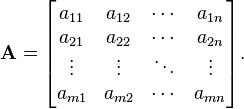
In mathematics, a matrix (plural matrices) is a rectangular array of numbers, symbols, or expressions, arranged in rows and columns. The individual items in a matrix are called its elements or entries. An example of a matrix with 2 rows and 3 columns is
\begin{bmatrix}1 & 9 & -13 \\20 & 5 & -6 \end{bmatrix}.
Matrices of the same size can be added or subtracted element by element. But the rule for matrix multiplication is that two matrices can be multiplied only when the number of columns in the first equals the number of rows in the second.
A matrix is a rectangular array of numbers or other mathematical objects, for which operations such as addition and multiplication are defined

 Matrices are commonly written in box brackets:

THE PROGRAM IS : 
#include<stdio.h>
#include<conio.h>
void main()
{
int a[10][10],b[10][10],c[10][10],i,j,k,m,n,p,q;
printf("Enter the size of the matrix A \n");
scanf("%d%d",&m,&n);
printf("Enter the size of the matrix B \n");
scanf("%d%d",&p,&q);
if(n!=p)
{
    printf("Matrix multiplication is not possible \n");
}
else
{
    printf("Enter the elements of matrix A \n");
    for(i=0;i<m;i++)
    {
        for(j=0;j<n;j++)
        {
            scanf("%d",&a[i][j]);
        }
    }
    printf("Enter the elements of matrix B \n");
    for(i=0;i<p;i++)
    {
        for(j=0;j<q;j++)
        {
            scanf("%d",&b[i][j]);
        }
    }
    for(i=0;i<m;i++)
    {
        for(j=0;j<q;j++)
        {
            c[i][j]=0;
            for(k=0;k<n;k++)
            {
                c[i][j]=c[i][j]+a[i][k]*b[k][j];
            }
        }
    }
    printf("Matrix A is \n");
    for(i=0;i<m;i++)
    {
        for(j=0;j<n;j++)
        {
            printf(" %d ",a[i][j]);
        }
        printf("\n");
    }
    printf("The Matrix B is \n");
    for(i=0;i<p;i++)
    {
        for(j=0;j<q;j++)
        {
            printf(" %d ",b[i][j]);
        }
        printf("\n");
    }
    printf("The resultant matrix is \n");
        for(i=0;i<m;i++)
        {
            for(j=0;j<q;j++)
            {
                printf(" %d ",c[i][j]);
            }
            printf("\n");
        }
}
getch();
}


Just copy and paste into your Microsoft Visual C++ or Turbo C (these are program developing software) 
Or else you can try this demo file and use it ... 
Click HERE to download this file. 
(Press ctrl+z and hit Enter to end the program).. 
~NOTE~ : While executing if you get any warning then just ignore it and continue with your program... 


IF FACE ANY PROBLEM DON'T FORGET TO COMMENT ...!!

Don't Forget to share.... 

Follow on Facebook : Ethical Hacking.


0 A C - PROGRAM TO FIND THE VALUE OF exp(0.5) USING TAYLOR SERIES

TAYLOR SERIES
The Taylor series of a real or complex-valued function ƒ(x) that is infinitely differentiable in a neighborhood of a real or complex number a is the power series
f(a)+\frac {f'(a)}{1!} (x-a)+ \frac{f''(a)}{2!} (x-a)^2+\frac{f^{(3)}(a)}{3!}(x-a)^3+ \cdots.  
1 + \frac{x^1}{1!} + \frac{x^2}{2!} + \frac{x^3}{3!} + \frac{x^4}{4!} + \frac{x^5}{5!}+ \cdots = 1 + x + \frac{x^2}{2} + \frac{x^3}{6} + \frac{x^4}{24} + \frac{x^5}{120} + \cdots\! = \sum_{n=0}^\infty \frac{x^n}{n!}.


 THE PROGRAM :
#include<stdio.h>
#include<math.h>
#include<float.h>
#include<conio.h>
void main()
{
    double x=0.5,e=1.0,term=1.0,fact=1.0;
    int i;
    for(i=1;term>=FLT_EPSILON;i++)
    {
        fact=fact*i;
        term=pow(x,i)/fact;
        e=e+term;
    }
    printf("\n Sum without using library function exp(%lf) = %lf \n",x,e);
    printf("\n Sum using library function exp(%lf) = %lf \n",x,exp(x));
    getch();
}

Just copy and paste into your Microsoft Visual C++ or Turbo C (these are program developing software)
Or else you can try this demo file and use it ...
Click HERE to download this file.

(Press ctrl+z and hit Enter to end the program)..
~NOTE~ : While executing if you get any warning then just ignore it and continue with your program...


IF FACE ANY PROBLEM DON'T FORGET TO COMMENT ...!!

Don't Forget to share.... 

Follow on Facebook : Ethical Hacking.

0 A C - PROGRAM TO FIND THE WORDLENGHT(without calling function) OF THE HOST MACHINE.

WORD LENGTH :

Word-length (also known as bit-depth) indicates how many digits are used to represent a value in a digital word. For instance, a word-length of 8-bits (8 digits) can only have values from 00000000 to 11111111 (in decimal, 0 to 255). A word-length of 16-bits can have values from 0000000000000000 to 1111111111111111 (0 to 65,536). A digital word doubles in resolution with each bit. For example a 16-bit sample has twice as many possible values (65,536) as a 15-bit word (32,768). 


THE PROGRAM IS :  
#include<stdio.h>
#include<conio.h>
void main()
{
    int count;
    unsigned int n;
    count=0;
    n=~0;
    while(n!=0)
    {
        n=n<<1;
        count++;
    }
    printf("word lenght of the machine is = %d bits \n",count);
    getch();
}


Just copy and paste into your Microsoft Visual C++ or Turbo C (these are program developing software)
Or else you can try this demo file and use it ...
Click HERE to download this file.

(Press ctrl+z and hit Enter to end the program)..
~NOTE~ : While executing if you get any warning then just ignore it and continue with your program...


IF FACE ANY PROBLEM DON'T FORGET TO COMMENT ...!!

Don't Forget to share.... 

Follow on Facebook : Ethical Hacking.